

Cash Assistance programs have become one of the most important safety nets for low-income families in 2026. As living costs continue to rise, millions of households depend on government support to manage basic needs like food, rent, healthcare, and education. However, alongside expanding financial aid, new poverty verification systems are also creating fresh debates about fairness, accuracy, and accessibility.
The main issue today is not just who receives assistance, but how eligibility is determined. Governments are trying to ensure that financial support reaches only genuinely deserving families, but stricter verification rules are also making the process more complicated for many applicants.
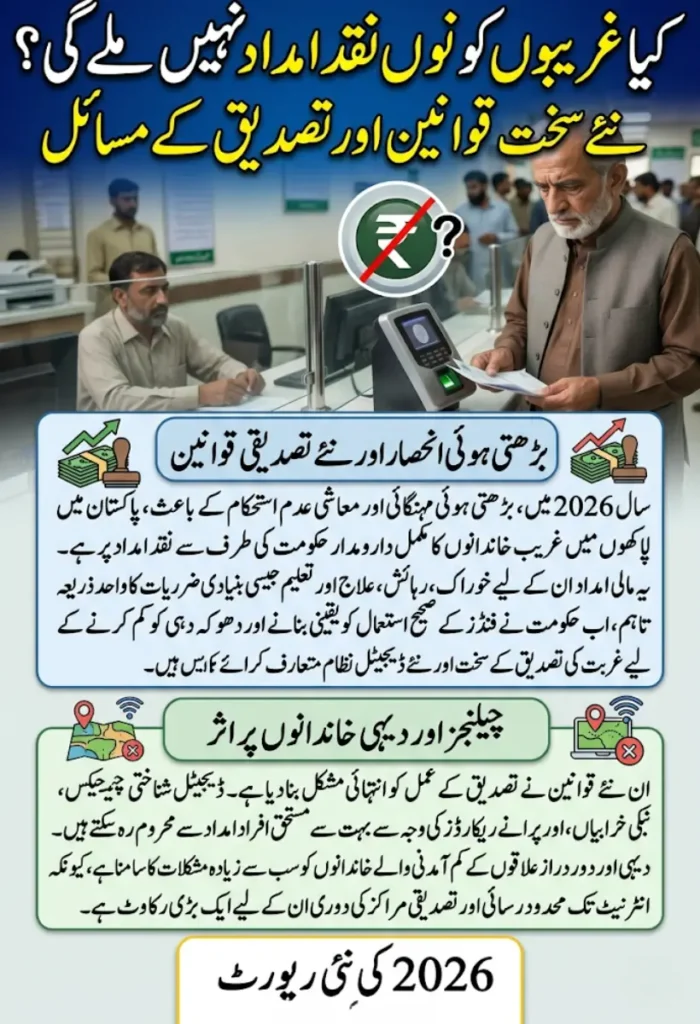
Growing Dependence on Cash Assistance Programs
Across many regions, cash assistance has shifted from a temporary relief tool to a long-term support system. Economic pressure, unstable job markets, and inflation have forced more families into government welfare programs.
For many households, these payments are the difference between financial stability and crisis. Even small increases in assistance can significantly impact daily survival, especially in low-income and rural communities where job opportunities are limited.
You Can Also Read : Green Tractor Scheme Phase 3
New Poverty Verification Rules in 2026
In 2026, governments have introduced updated poverty verification systems designed to reduce fraud and improve transparency. These systems often rely on digital records, household surveys, and identity checks to determine eligibility.
While the intention is to make the process fairer, the new rules have also made approval more complex. Many applicants now face repeated verification steps before receiving approval, which can delay financial support when it is needed most.
Digital Identity Checks and Their Challenges
One of the biggest changes in welfare systems is the shift toward digital identity verification. Instead of manual checks, applicants are now verified through computerized databases linked to national identification systems.
This modernization has improved efficiency in many cases, but it is not without problems. Technical errors, outdated records, and mismatched data can still block eligible families from receiving payments.
Some common challenges include:
- Incorrect or outdated household information in databases
- Delays in updating eligibility after income changes
- Technical issues during biometric or digital verification
Impact on Low-Income and Rural Families
The stricter verification process has had a stronger impact on low-income households, especially those living in rural or remote areas. Limited internet access, lack of documentation, and distance from verification centers create additional barriers.
For many families, completing the process requires time, travel expenses, and repeated visits to government offices. This increases frustration and sometimes discourages eligible individuals from applying at all.
Concerns About Exclusion and Fairness
One of the biggest concerns in 2026 is the risk of excluding deserving families due to system errors or strict eligibility filters. While governments aim to reduce misuse of funds, overly rigid systems can unintentionally remove vulnerable households from assistance lists.
Experts argue that poverty is not always easy to measure through data alone. Sudden job loss, informal income, or temporary financial shocks may not be accurately reflected in digital systems, leading to incorrect rejections.
Key Issues in the Current Verification System
The ongoing concerns around poverty verification can be summarized through a few major challenges:
- Difficulty in keeping household data updated in real time
- Delays in approving or re-verifying eligible applicants
- Limited awareness among citizens about new verification requirements
These issues highlight the gap between policy design and real-world implementation, especially in developing welfare systems.
You Can Also Read : Today Silver Prices and Market Rate Updates
The Future of Cash Assistance Systems
Looking ahead, cash assistance programs are expected to become more advanced and technology-driven. Governments may continue improving digital databases, automation tools, and identity systems to reduce errors and speed up processing.
However, the success of these systems will depend not only on technology but also on accessibility. A fair welfare system must balance strict verification with simplicity, ensuring that no deserving family is left behind due to technical or administrative barriers.
Conclusion
The cash assistance programs in 2026 stand at a critical point. While stronger verification systems aim to improve transparency and reduce misuse, they also bring new challenges that affect vulnerable communities. The future of welfare will depend on finding the right balance between accuracy, fairness, and ease of access so that support reaches the people who need it most without unnecessary obstacles.